
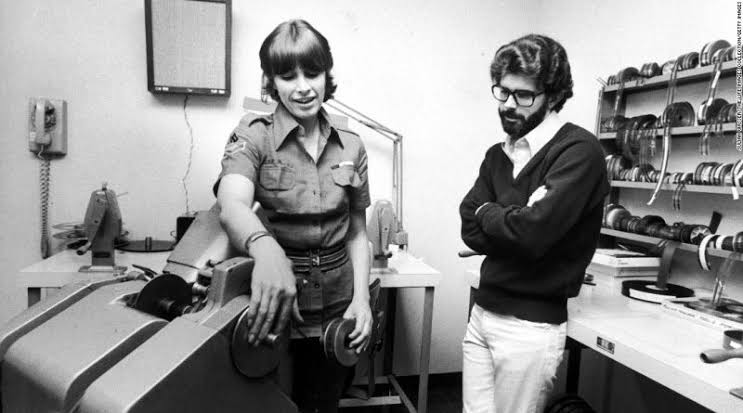
There’s a version of the New Hollywood story you’ve probably heard. Scorsese, Coppola, Spielberg, Lucas, Altman… the movie brats and mavericks who blew up the old studio system and replaced it with something rawer, stranger, more alive. It’s a great story. And for the most part it’s true… again, mostly.
But it leaves out something important.
Almost every one of those films …every landmark, every watershed moment from the late ’60s through the early ’80s, was shaped in a dark room by a woman with a razor blade. And the directors getting the magazine covers and the auteur theory treatment knew it.
Marcia Lucas, 1945–2026
We’re writing this because Marcia Lucas died on May 27, 2026, at her home in Rancho Mirage, California. She was 80 years old. The cause was metastatic cancer. She was surrounded by people who loved her.
Her family’s statement said she would be remembered as, “a brilliant storyteller, a trailblazer for women in film, a loving mother and grandmother, a generous host, and a loyal friend whose humor and sparkle filled every room she entered.”
That’s a beautiful thing to have said about you. It also undersells what she did to cinema.
Born Martha Griffin in Modesto, California, Marcia Lucad did not come up through film school. She got herself into the Motion Picture Editors Guild apprenticeship program and spent eight years working her way up from film librarian to assistant editor to full editor. Eight years. No shortcut or connection, no family legacy in the industry. Just stubbornness and an instinct for story that turned out to be extraordinary.
She would go on to edit THX 1138. American Graffiti (earning her an Oscar nomination alongside her mentor Verna Fields). Alice Doesn’t Live Here Anymore. Taxi Driver (as supervising editor, one of the most viscerally precise films ever put together). New York, New York. Star Wars: A New Hope, (for which she won the Academy Award for Best Film Editing in 1978, shared with Paul Hirsch and Richard Chew). Return of the Jedi.
That’s not a filmography… it’s a syllabus.
On Star Wars, her influence went well beyond the cutting room. It was Marcia who argued that Obi-Wan Kenobi should die in his duel with Darth Vader. She argued that his death would deepen the threat of the dark side and give Luke a spiritual anchor. George Lucas himself credited her with that idea in a 1977 Rolling Stone interview. Mark Hamill said she was the one who convinced George to keep the little “kiss for luck” before he and Carrie Fisher swing across the chasm. This is a moment that does more character work in three seconds than most films manage in an act. And the climactic Death Star battle sequence? That was assembled from roughly 40,000 feet of footage; a puzzle that by all accounts should have been impossible, and wasn’t.
She once told a reporter: “I love film editing. I have an innate ability to take good material and make it better, and to take bad material and make it fair.” I love that quote. It’s so matter-of-fact about something that is genuinely, deeply hard.
The Edit Room Was Theirs
Marcia Lucas wasn’t an anomaly. She was part of a generation.
Editing had long been one of the few above-the-line creative positions where women could actually get hired in Hollywood, partly because it was considered “detail work,” which is its own grim little story, and partly because Margaret Booth and a handful of others had established a beachhead there going back to the silent era. By the time New Hollywood arrived, the edit room was one place where women held serious creative authority. And they used it.
Dede Allen was already a legend by the time the ‘70s started. Her work on Bonnie and Clyde in 1967 had essentially invented the grammar of American action editing; the jump cuts, the rhythmic violence, the way a sequence could feel both chaotic and inevitable at once. She went on to cut Dog Day Afternoon, Serpico, Slaughterhouse-Five. Sidney Lumet and Arthur Penn kept coming back to her because she didn’t just execute a director’s vision…she pushed back, refined it, made it more itself.
Verna Fields was Marcia Lucas’s mentor and is probably most famous for Jaws… yes, the movie that essentially invented the summer blockbuster was edited by a woman, and almost in real time (the main reason it was released on time after going dramatically over schedule). She also cut Paper Moon and American Graffiti. She taught film editing at USC. She was the person who brought young George Lucas into a professional environment in the first place, which means she’s indirectly responsible for a lot of what happened to cinema in the late 20th century. She won the Academy Award for Best Film Editing for Jaws in 1975. She died in 1982 at 64. She is not nearly famous enough.
Thelma Schoonmaker is the long game. She met Martin Scorsese when they were both starting out at NYU, edited his early work, and then, after a nearly decade-long gap caused by union blacklisting over Woodstock, became his permanent collaborator starting with Raging Bull in 1980. She has won three Academy Awards. She has cut every Scorsese film since. Raging Bull. Goodfellas. The Aviator. The Departed. The Irishman. When people talk about Scorsese’s rhythm, like the way violence arrives suddenly and recedes into silence, the way music and image create a kind of vertigo… they’re describing Thelma Schoonmaker’s work as much as his. She understood this herself. She’s said that great editing is supposed to be felt, not seen…that the goal is pace and rhythm and drama, not the machinery behind it.
That invisibility is the point. And it’s also, historically, part of the problem.
The Credit Gap
Here’s the uncomfortable part. The directors got the auteur theory. The editors got the dark room.
The intellectual framework that dominated film criticism from the ‘60s onward (the idea of the director as sole author, the singular artistic vision, the mise-en-scène and all that) was not wrong exactly, but it was incomplete in ways that conveniently erased the contributions of mostly women. Scorsese without Schoonmaker is a different filmmaker. George Lucas without Marcia Lucas…well, there’s a reasonable argument that Star Wars doesn’t work, doesn’t become the cultural object it became, without her shaping hand in post-production.
The people who got the magazine covers were the people who showed up on set. The people who worked in the edit suite (often for longer, and often on harder problems) got less.
This is not a small thing. Recognition shapes careers, and shapes who gets hired as a director next time. Recognition shapes who gets to tell which stories.
Since Then: The Slow Math
You’d think things would have gotten dramatically better. You’d be partially right.
Chloé Zhao won the Academy Award for Best Directing for Nomadland in 2021. She is the first woman of color to win in that category, which is a milestone that also tells you something about how long it took. Ava DuVernay has built a producing empire. Greta Gerwig made Barbie into one of the highest-grossing films in history. The 2020-21 TV season saw women directing 38% of all episodes; a number that was in the single digits not that many years ago.
These are real things worth celebrating.
And yet… the Celluloid Ceiling study from San Diego State University, which tracks women in key behind-the-scenes roles on the top 250 U.S. films, has been delivering the same uncomfortable verdict for years: progress is real and it is slow. As of the most recent data, only about 25% of all combined directing, writing, editing, producing, and cinematography roles on major studio films are held by women.
It took 98 years, but this past March, Autumn Durald Arkapaw won the Academy Award for Best Cinematography for Sinners. The first woman ever to do so, and in her acceptance speech she asked every woman in the Dolby Theatre to stand up, because she knew she didn’t get there alone. Still, cinematography in particular remains stubbornly gate kept, with women holding around 7% of director of photography credits on the top films.
Editing, the craft that gave women their foothold in the first place, has seen women hold roughly 22% of credits in recent years. Which is more than directing and writing, but still not where you’d expect it to be given the history.
And women in the editing room are still defining the auteur directors of today. Editor Sarah Flack (who shaped Sofia Coppola’s entire run from Lost in Translation to On the Rocks) rebuilt Steven Soderbergh’s The Limey from scratch alongside Soderbergh after a disastrous first cut, turning what he called a, “vortex of terror” into one of the most inventive films in American independent cinema; Of his collaboration with Flack, Soderbergh said: “If there’s such a thing as a Purple Heart in the entertainment industry, Sarah should have one.” He also said that whenever post-production gets hard, he reminds himself, “…at least it’s not The Limey.”
The #MeToo reckoning of 2017 changed the culture of abuse and misconduct in meaningful ways. A WIF survey found that experiences of abuse and misconduct had fallen significantly by 2023, and the majority of industry respondents felt things had improved. That matters enormously. The structural employment numbers have been slower to follow.
What the Edit Room Taught Us
Here’s what Astoria Picture Show believes, in case you’re wondering why a film organization in a small coastal Oregon town is writing a post like this:
Cinema is a collaborative art form. The auteur theory is a useful critical lens and a deeply misleading production mythology. The directors who made the great films of the ’70s and ’80s were great partly because they surrounded themselves with collaborators who were also great; and a striking number of those collaborators were women who had figured out how to do extraordinary work in a system that was structurally indifferent to their careers.
Marcia Lucas was one of those people. She is not a footnote to George Lucas’s story. She is a principal author of some of the most watched films in human history.
We’re sad she’s gone. We’re glad she got to 80, surrounded by loved ones, having made the work she made.
And we think the next time you watch Star Wars (any version, any generation of the audience) you should know her name.
Marcia Lou Griffin Lucas. October 4, 1945 – May 27, 2026. RIP.
Astoria Picture Show programs film because film matters — to communities, to history, to the ongoing human project of understanding each other.
