
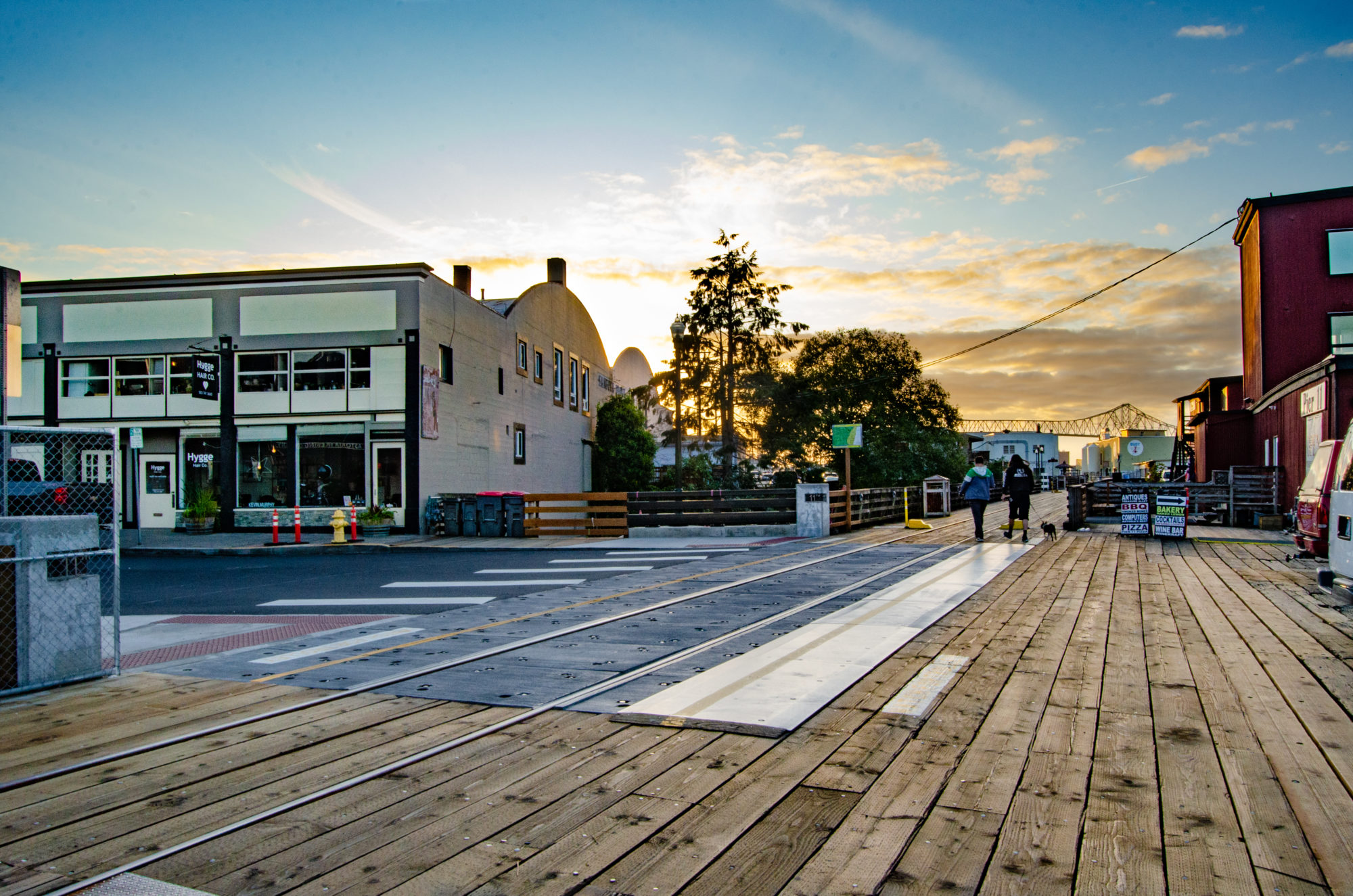
There’s a version of small-town history where the past gets cleared away to make room for whatever comes next. The Victorian houses come down for ranch-style sprawl. The working waterfront completely disappears, making way for all-new Anywhere USA structures. The old essentially becomes a memory instead of a neighbor.
Astoria didn’t really do that. Drive or walk through town and you can feel three or four different eras occupying the same streets at once, none of them pretending to be in charge. The column on the hill still points at 1811 like someone might need reminding. And just like the people who came before, most of the businesses of the past aren’t here any more. But their buildings are mostly still standing, even if what happens inside them has changed. Fishing boats still share the waterfront with craft espresso. It’s not a theme park version of the past, and it’s not a rebrand of the present. It’s just… still here. All of it.
That layering is the most Astoria thing about Astoria. It’s also the reason we started Astoria Picture Show.
The trap inside the magic
Here’s the part that doesn’t get said enough: the same layering that makes this town feel so alive is also what keeps it quietly divided. Fishing families, the old-guard arts crowd, the wave of remote workers and tech refugees who landed here for the fog, the Coast Guard families making the most of their assignments, the vintage shop owners, the folks who’ve been here five generations and the folks who’ve been here five years… they can all love this town fiercely and still never end up in the same room.
Not because anyone’s hostile to anyone else. Just because that’s what happens to small towns with deep layers and no obvious mechanism for cutting across them. Affection for a place doesn’t automatically translate into contact with the people who also love it.
We think film is one of the few things left that can do that work. Not because everyone loves movies in some abstract universal sense (though most people do) but because watching something together, in the dark, is one of the last shared formats that doesn’t require you to already know somebody. You show up. You sit. You feel something alongside strangers. You spill back out onto the street afterward, and now there’s a conversation to have, with whoever happens to be standing next to you.
But that only works if we’re honest about something: no venue is neutral. The Liberty Theatre carries one set of associations. A classroom at Clatsop Community College carries another. Where you choose to show a film is already a kind of invitation… and an exclusion, whether you mean it that way or not. Pretending otherwise doesn’t make APS more universal. It just makes the unevenness invisible.
Moving instead of settling
So we’ve been asking ourselves a different question than, “how do we build one home for this organization.” We’ve been asking: what does it look like for APS to actually move? Different venues. Different neighborhoods. Different audiences, on purpose, instead of by accident.
The silos in this town aren’t going to dissolve, and we’re not under the illusion that a few screenings will dissolve them. What we can do is put doors in the walls. Show films in different rooms with different framings. Let a high schooler’s reason for caring about a movie be completely different from a longtime fisherman’s reason, and treat both as legitimate, because they are.
That’s the thinking behind a lot of what’s coming from APS this year. Not one audience we’re trying to capture, but several audiences we’re trying to introduce to each other, slowly, film by film.
Why young people are the most critical audience we need
If there’s one silo we’re being deliberate about right now, it’s the high school and college-age crowd; and we’re being deliberate because the cost of getting it wrong is high. If APS becomes coded early on as, “for adults who already love cinema,” that reputation calcifies fast, and you spend the next decade trying to undo a first impression nobody meant to make.
The thing is, this generation isn’t disconnected from film. They might be the most film-saturated generation there’s ever been; they just relate to it differently. Reverence isn’t really the mode. They’re not waiting for permission to have opinions about a movie; they’ve had a phone in their hand since middle school and a comments section to argue in. What lands with them isn’t education. It’s being provoked, given something worth arguing about, and credited with already having a film brain worth taking seriously.
That’s part of why partnerships with local film coursework matter to us, and why we’re interested in pursuing dual-enrollment pathways that connect high schoolers to college-level film study. It’s not just a pipeline. It’s a signal: this counts, your interest in this counts, you don’t have to wait until you’re older to be taken seriously here.
It’s also why programs that hand someone a camera tend to do more than programs that hand someone a seat. Watching is one relationship to film. Making is another. APS wants room for both.
The same film, two doors in
One of the more useful exercises we’ve put ourselves through lately is taking a single film and asking how it could mean something different to two audiences without becoming two different events. A so-bad-it’s-good midnight movie, for instance, isn’t really one experience… it’s two experiences that happen to be in the same room. For longtime audiences, it’s nostalgia-adjacent: the VHS era, the lineage of midnight screenings, the memory of finding a terrible movie and feeling like you’d found contraband. For younger audiences, the same film lands through irony culture and a comfort with intentional cringe that’s already native to how they watch everything.
Same screen. Same two hours. Different doors in. That’s the model we keep coming back to: not picking an audience and serving it well, but finding the films and the framing that let several audiences walk in from different directions and end up, unexpectedly, talking to each other in the lobby afterward.
Still here, all of it
Astoria kept its layers instead of flattening them, and that’s a rare and lucky thing for a town to do. The work in front of APS isn’t to add another layer that sits on top, separate from the rest. It’s to be the thing that occasionally reaches sideways; between the layers, between the rooms, between the people who all love this place and have simply never had a reason to be in the dark together.
We don’t think that happens with one screening, or one season. But it starts the same way most good things in this town seem to: by showing up, again and again, in more than one place, and leaving the door open behind us.
