
Here’s a question worth asking: why did a nearly three-hour, R-rated movie based on a poem older than reading itself just shake up the global cultural zeitgeist?
Not “did it.” It did…the best debut of Christopher Nolan’s career and the third-biggest opening of the year, against films that had entire theme parks behind them. The interesting question is why. Half the opening weekend audience was under 35. There’s no franchise, shared universe, or sequel already booked. Just Homer (well, maybe), three thousand years of homework flashbacks, and a studio that spent $250 million on the bet that people still wanted this.
Seems that we did. And based on the cultural discussion around the film, we wanted it a lot.
What Nolan Actually Built
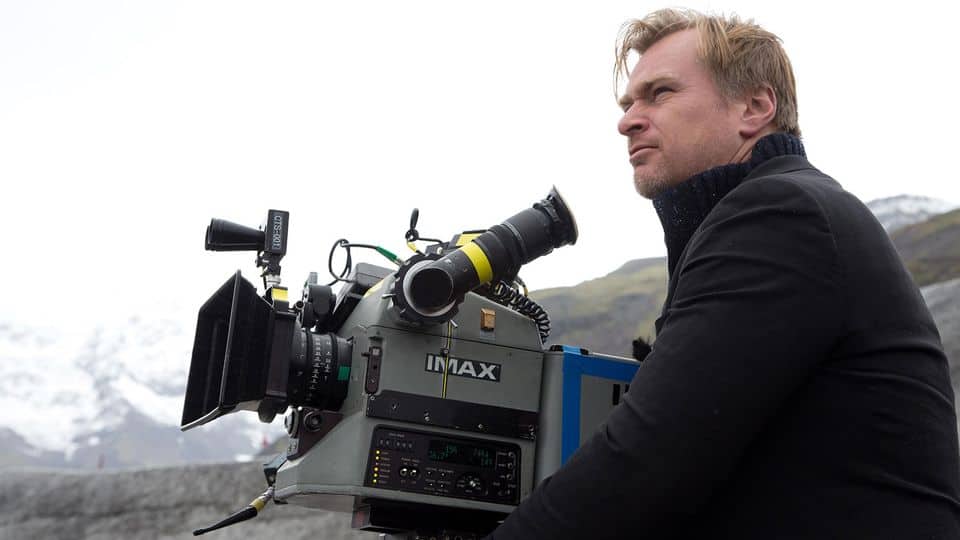
Nolan has spent his whole career arguing that a green screen is a failure of imagination, not a solution, and The Odyssey is where he took that argument as far as it goes. The Cyclops is a sixty-foot practical rig built inside an actual cave in the Peloponnese, with actor Bill Irwin (who previously spent his time bringing the robot TARS to life in Interstellar) inside it, giving the creature something to be rather than something to render. When Circe turns Odysseus’s men into pigs, that’s animatronics operated by Samantha Morton, not a digital morph. The whirlpool, the sirens, the sea monster — built, rigged, and shot for real wherever physics would allow it, with visual effects filling in only what physics wouldn’t.
Nolan has said the whole approach came down to one question on set: what would this actually be like? Not a storybook monster. A real individual, with a real body occupying real space, that the actors could actually be afraid of. That’s a direct line back to Ray Harryhausen, whose stop-motion creatures convinced generations of moviegoers they were watching something alive rather than something animated — and more than sixty years later, apparently, that trick still works better than the expensive one.
There’s something stubborn about spending that kind of money to do things the hard way. We happen to think stubbornness is underrated.
The Argument Under the Argument
For maybe two weeks, the loudest conversation about this movie had nothing to do with any of that. It was casting discourse… the usual internet weather system, blowing through, mostly unconnected to anything actually on screen. Several critics pointed out that a film with no discernible modern politics beyond, “war is bad and so is breaking with tradition” had somehow been dragged into one anyway.
I’d say that the conversation worth having is underneath that one. Homer’s poem survives because it keeps finding new centuries to talk to, and the two ideas Nolan leans on hardest are nostos (homecoming, and the question of whether the person who left can still be recognized by the life left behind), and xenia, the ancient obligation of hospitality: you feed the stranger at your door because you don’t know if he’s a beggar or a god in disguise, and either way it’s not your call. A scholar at Harvard put it well in the run-up to release: the poem has always been about relationships tested by displacement and time, which is a very old problem wearing very current clothes. Watching a summer blockbuster that asks what a society owes to the person who washes up on its shore turned out to be more interesting than any of the noise around it.
Why We’re Watching This Closely
We run a film school in a town of ten thousand people at the rainy end of the Oregon coast, so we’re obviously not the target audience Universal’s marketing department had in mind. But we keep coming back to the same thought: the biggest movie of the summer just made its case, at enormous expense, for the same thing we make ours over for free: that craft you can see and touch still beats craft that only exists in a render farm, and that audiences, whether there are twenty of them in a community college classroom or twenty million of them in theaters worldwide, can feel the difference even when they can’t say why.
That’s not nostalgia. Nolan didn’t build a sixty-foot Cyclops because computers can’t do monsters anymore… obviously they can, and probably cheaper and faster. He built it because a puppet in a real cave gives an actor something true to react to, and that truth survives all the way to the screen. It’s the same reasoning behind teaching people why a filmmaker chose to light a scene a particular way before we ever ask how. Tools always scale up. The intention, motivation and instinct underneath the decision is what matters most.
Homer’s been on the syllabus for three thousand years. Turns out he’s still teaching.
Registration for our Fall ’26 FILM 1 and 2 courses is open now — FILM 2 picks up where FILM 1 leaves off, into planning, production, financing, and distribution. Fewer sea monsters, same basic idea: build the real thing.
