
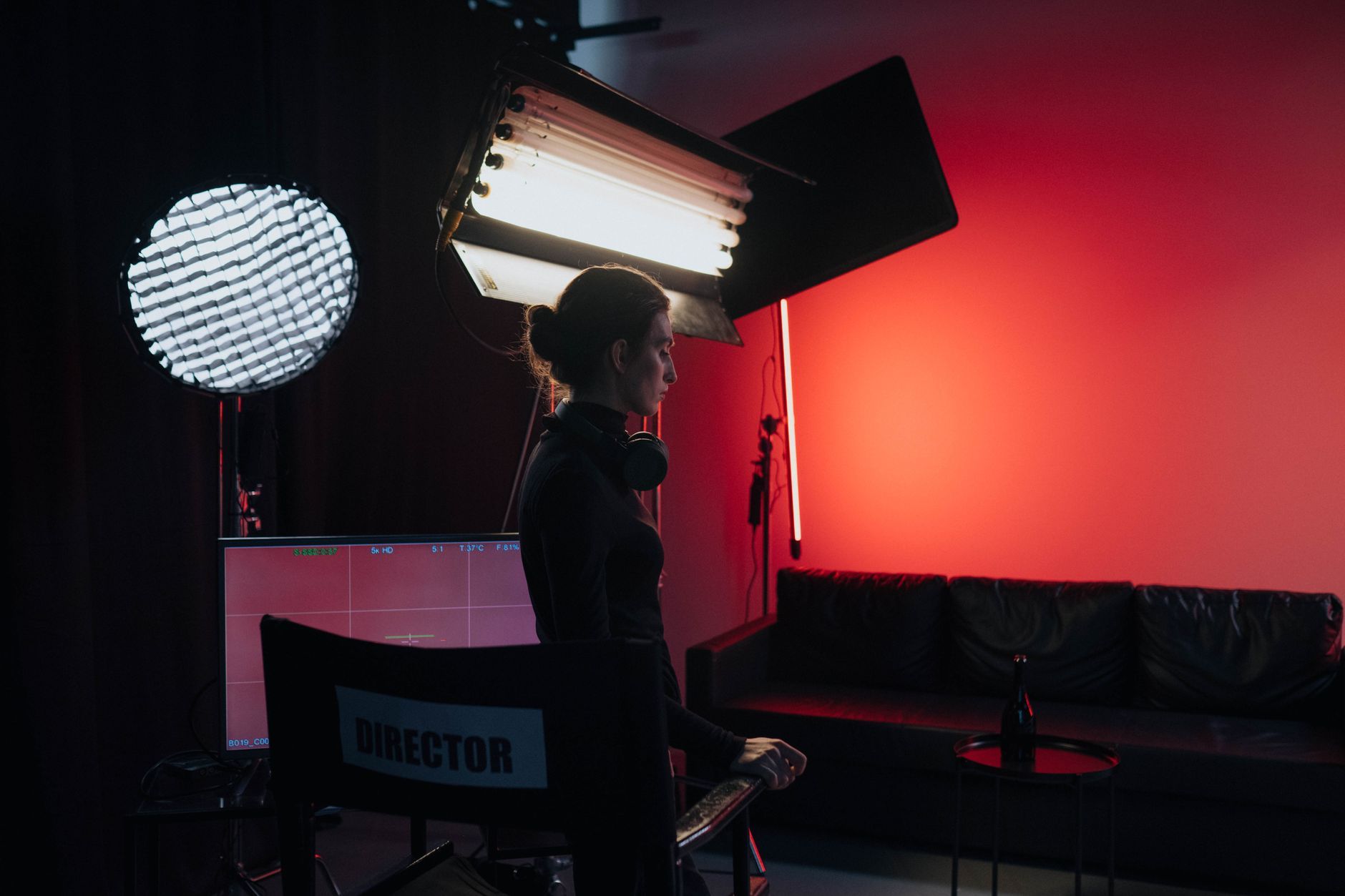
Here’s a number that should not be true for a beginner filmmaking class in a town of about ten thousand people: nearly two dozen. That’s how many showed up for the first session of our Film 1 class at Clatsop Community College. Some people put a lot of miles on their car to be there. That’s not a casual Wednesday-night commute by anyone’s math, and yet there they were, gathering like they’d been waiting for someone to finally offer this.
We’d like to tell you we saw it coming. We didn’t, not exactly. You can believe in something… that people want to understand how stories are told in moving pictures and how movies actually get made… that curiosity about the craft doesn’t stop at the city limits of places with film schools. But you can still be a little stunned when a room full of strangers proves you right.
What struck us more than the headcount was the range. This wasn’t a classroom of twenty-two people who all wanted the same thing. We had folks who’d clearly been carrying a screenplay around in a drawer for years, finally giving it permission to exist. We had people who just want to know what a director actually does all day, as opposed to what the Oscars broadcast implies a director does all day (mostly, it turns out, thanking their agent). And we had people who couldn’t quite articulate what they wanted, only that some movie, at some point, had gotten under their skin in a way they couldn’t explain, and they wanted to understand the mechanics of how that happens.
Because that’s the thing about how people talk about wanting to learn filmmaking…they rarely lead with the technical stuff. Nobody walks in asking about aspect ratios. They ask how a story gets from somebody’s head onto a screen, and why watching that story land can rearrange something in you that a conversation never would. That’s not a small question. It’s arguably the only question. Every choice a filmmaker makes… where the camera sits, when the cut happens, what’s left out of the frame entirely… is in service of that one transaction between a screen and a person sitting in the dark. Learning to see those choices doesn’t ruin the magic trick. It just means you start noticing the hands. That’s our Intro to Cinema class.
There’s a version of this that would feel a little rich coming from a town whose relationship to film has mostly been as a backdrop. Astoria has spent more than a century getting cast as somewhere else, going all the way back to a Selig Polyscope crew showing up in 1909 to shoot The Fisherman’s Bride. We’ve been a jail, a summer camp, an orca-adjacent marina. We are extremely good at being where other people’s stories happen. What we haven’t had, historically, is much infrastructure for turning that into our own stories… the actual mechanics of it, taught to whoever in town happened to want in. That’s the gap Astoria Picture Show exists to close, and it’s a different kind of project than putting up a plaque where a movie once stood. A plaque tells you something happened here. A classroom lets you make the next thing happen.
So: nearly two dozen people, spanning an age range wide enough that we’re fairly sure the youngest person in the room and the oldest have never agreed on a single working definition of “new music,” sitting together and asking, essentially, the same set of questions. How do you take an idea and structure it so it holds a room’s attention. How do you get from a script to something you can actually point a camera at. How does the machinery of it all… the parts nobody puts in the trailer… end up mattering as much as the parts that do. That’s not a niche interest. That’s just what happens when you tell people the curtain can be pulled back and it turns out they’d been hoping someone would ask.
All of which is our long way of saying: we’re doing it again. Film 1 returns this fall for another term, for anyone who missed the first round or knows someone who did (to whoever put a bunch of miles on their odometer for round one: we appreciate you). But we’re also adding something new. Film 2 is where things get less dreamy and more load-bearing: the planning, the production logistics, the financing, the distribution. The parts of filmmaking that don’t get a chapter in most people’s mental model of “how movies happen,” mostly because they’re less romantic than “inspiration strikes” and more like “how do we pay for the second week of the shoot.” It’s the nuts and bolts, and also, not coincidentally, the reason most good ideas never make it to a screen at all. If Film 1 is about learning to see the choices, Film 2 is about learning to survive making them.
This is, more or less, the whole case for why we do this. Not because Astoria needs another reason to feel proud of its cinematic resume; we’ve got plenty of those already, filed somewhere between The Goonies and Sometimes I Think About Dying. It’s because understanding how films get made, and why they land the way they do, isn’t just trivia for people who already call themselves cinephiles. It’s a kind of literacy that enriches our lives. And apparently, given the chance, people will drive quite a bit to go get it.
Film 1 and Film 2 both run this fall. Details and registration will be up on the site soon; come find out what the fuss was about, however many miles you’ve got to drive to get here.
