
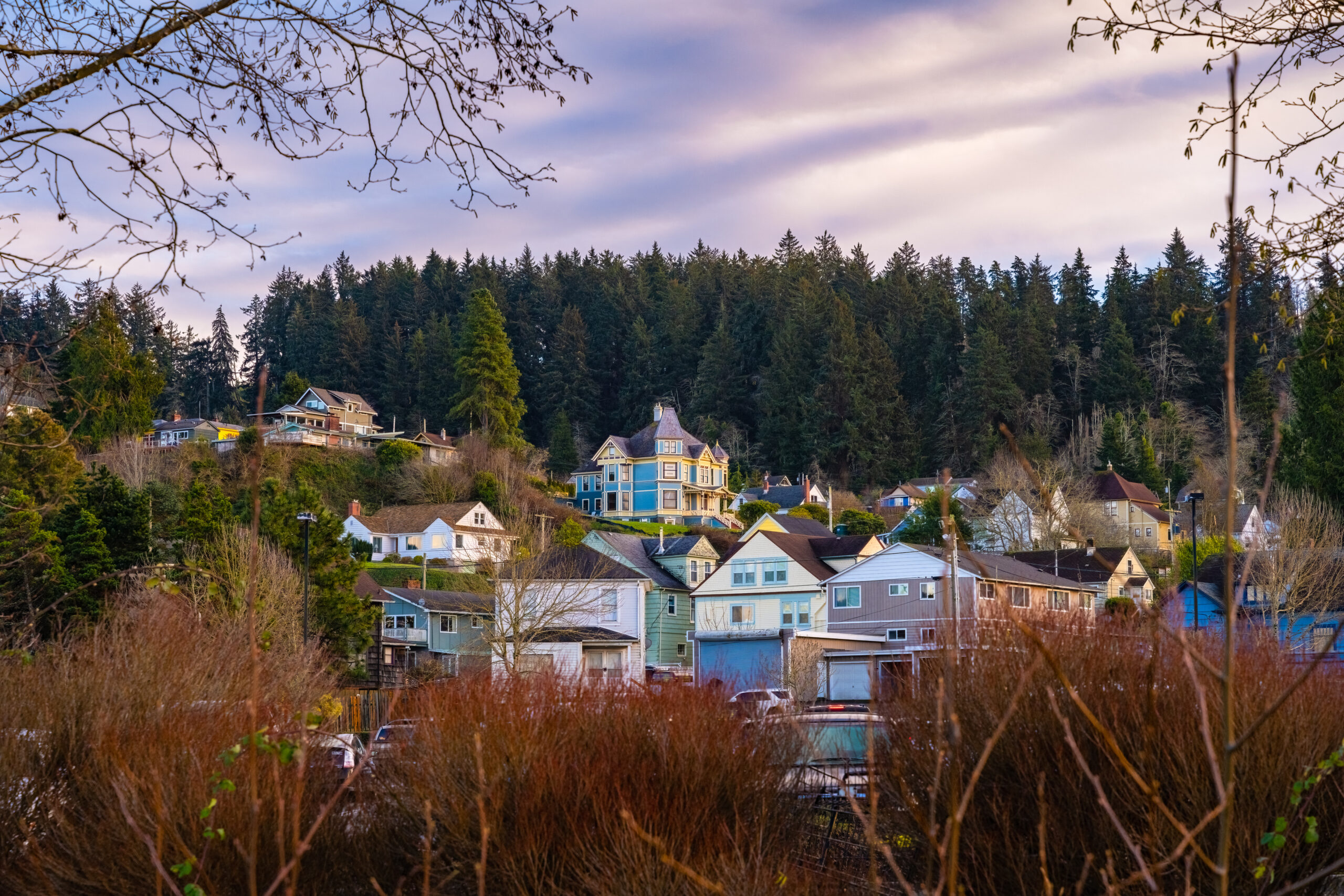
There’s a question worth asking: why here?
Not in a self-deprecating way. We know why we love this town. But from a purely logistical standpoint, why would a studio in Los Angeles, with the entire continental United States at its disposal, keep sending film crews to a small fishing and cannery town at the rainy end of the Oregon coast? Why did the production designer for The Goonies look at Astoria and say, yes, this is the place? Why did Ivan Reitman follow with Kindergarten Cop? Why did Free Willy, Short Circuit, The Ring Two, Into the Wild, Green Room, and Wendy and Lucy all make the same unlikely pilgrimage to the same unlikely small town?
The easy answer is scenery. The river, the bridge, the Victorian architecture, the fog doing its fog thing. All true. But scenery doesn’t explain the pattern. Oregon has scenery everywhere. Cannon Beach is beautiful. The Willamette Valley is beautiful. Portland has infrastructure and crew and a film office that’s been actively recruiting productions since 1968. Yet Astoria keeps showing up on call sheets in a way that completely outpaces its size.
There’s a better answer. And it turns out to be the same thing that makes this a good place to build a film organization, which is either a tidy coincidence or exactly the point, depending on how charitable you’re feeling.
The Thing Reitman Actually Said
When Ivan Reitman chose Astoria for Kindergarten Cop, his production coordinator explained the reasoning in terms that had nothing to do with the scenery. Reitman liked that it was a waterfront town that wasn’t a resort town. A working place. Somewhere that fishermen still pulled into the marina and unloaded actual catch onto actual docks. Somewhere that hadn’t been smoothed into a version of itself designed for visitors.
That’s a cinematically specific thing to want. What Reitman was describing is authenticity… not as a lifestyle brand concept, but as a production asset. A town that looks like a real place because it is one. Streets where the architecture wasn’t installed to create atmosphere but simply was never torn down. Buildings with actual wear. Waterfronts with actual commerce. The kind of specific, textured, unperformed reality that costs an enormous amount of money to fake and is essentially free when you find it.
Astoria has never tried very hard to look like anything other than what it is. That turns out to be exactly what film keeps coming back for.
A Town That Passes for Everywhere
There’s a second thing, and it’s stranger.
Astoria is not just authentic… it’s versatile in a way that only places with particular geographic density can pull off. The town sits where the Columbia River meets the Pacific Ocean, with coastal forest climbing the hills behind it and mountains accessible as a day trip. Mac Burns, executive director of the Oregon Film Museum, puts it simply: filmmakers come here because you can be “a river town, close to the ocean,” surrounded by forest, with mountains not far behind. Which sounds like he’s reading from a brochure, but he’s actually describing a production budget advantage.
The result is that Astoria has played a remarkable variety of places on screen. It’s been small-town Pacific Northwest (obviously, in The Goonies). It’s passed for rural California (Kindergarten Cop). It hosted the ocean sequences for Free Willy. And then (and this is the one that gets me) the Teenage Mutant Ninja Turtles III production spent $300,000 converting a Tongue Point hangar into a four-stage studio to simulate feudal Japan. Ancient Japan. In Astoria. I love this town.
It’s also carried the dread of The Ring Two, and grounded the lived-in melancholy of Sean Penn’s Into the Wild. That range isn’t an accident. It’s what happens when a place has layers (geographic, architectural, historical) that don’t resolve into a single identifiable look. Astoria isn’t postcard-flat. It has depth, and cameras are deeply attracted to depth.
It Started Earlier Than You Think
Here’s the part most people don’t know, and it’s genuinely wild.
The film industry’s relationship with Astoria doesn’t begin with The Goonies. It begins in 1909, when the Selig Polyscope Company, a Chicago-based outfit that would soon build the first permanent film studio in Los Angeles and effectively invent what we now call Hollywood , sent a crew here to shoot The Fisherman’s Bride. It’s a short drama about two men competing for a young woman’s hand, set on the working waterfront, involving a shanghaied groom, the Coast Guard, and a last-minute wedding rescue. It is the first scripted commercial film ever made in Oregon.
The same year, Colonel Selig converted an old Los Angeles mansion into a production studio and kicked off the film industry’s West Coast expansion. The company that discovered Astoria invented Hollywood. If you want to be technical about it, Astoria was there first.
That lineage has never entirely stopped. The town that helped launch American commercial cinema in 1909 was still welcoming crews in 2024, when The Cycle crew setup shop, and last summer, when no fewer than two independent productions picked up dailies for weeks on end. The legacy isn’t nostalgia; it’s a living, ongoing relationship between this particular place and the people who make films.
What Hollywood Forgot
Here’s where things get really interesting.
The same qualities that have made Astoria a reliable location for over a century (authenticity, texture, the absence of performed identity) are exactly what mainstream studio filmmaking has been systematically eliminating for the past two decades. The studio instinct now runs in the opposite direction: controlled environments, digital sets, franchise familiarity, IP that has pre-sold its own aesthetic. If you can render a world entirely in post, you don’t need Astoria. You don’t need anywhere.
But audiences can feel that absence, even when they can’t name it. There’s a reason The Goonies still lands emotionally with people who weren’t alive when it was made, while films with five times the budget and forty times the visual effects feel oddly weightless. The difference is that The Goonies was shot somewhere. The kids are running through actual Astoria streets. There’s mud. There’s a real ocean at the end of the chase. Real place produces real stakes in a way that virtual production hasn’t figured out how to replicate… and I’d argue isn’t going to, no matter how good the LED walls get.
The qualities that studios have decided are obstacles (the rain, the fog that comes in and completely changes the light, the unglamorous working waterfront that doesn’t photograph like a set) are exactly the qualities that produce films worth watching. Astoria knew this a hundred years before anyone in Hollywood thought to put it in a memo.
Why This Is Our Starting Point
Astoria Picture Show exists partly because of this history and partly because of what it implies. We’re in a town that has been a location, over and over, for more than a century; not because of studio infrastructure or tax incentive programs, but because the place itself is cinematic. It has what the movies keep coming back for.
The question we keep asking is: what does it mean to be a film organization in this town, rather than just in a town? The geography that brought film crews here is the same geography our film school students shoot in. The architectural layers that gave The Goonies its look are the same layers that make this a genuinely excellent classroom for learning to think about visual storytelling. The fact that you can walk out of a film class at Clatsop Community College and immediately be standing in a location that a Hollywood cinematographer chose for its light… that’s not incidental. That’s the whole argument.
We don’t think you have to go to Los Angeles to learn about film. Part of what we’re building at APS is the case that you don’t even have to leave Astoria. The town has been making that case since 1909. We’re just finally paying attention.
The Oregon Film Museum is at 732 Duane St. If you haven’t been, go. It’s housed in the old Clatsop County Jail (the one from the opening of The Goonies) and it is one of the great small cultural institutions on the Oregon coast.
APS runs programming in partnership with Clatsop Community College, including our Film School.
