
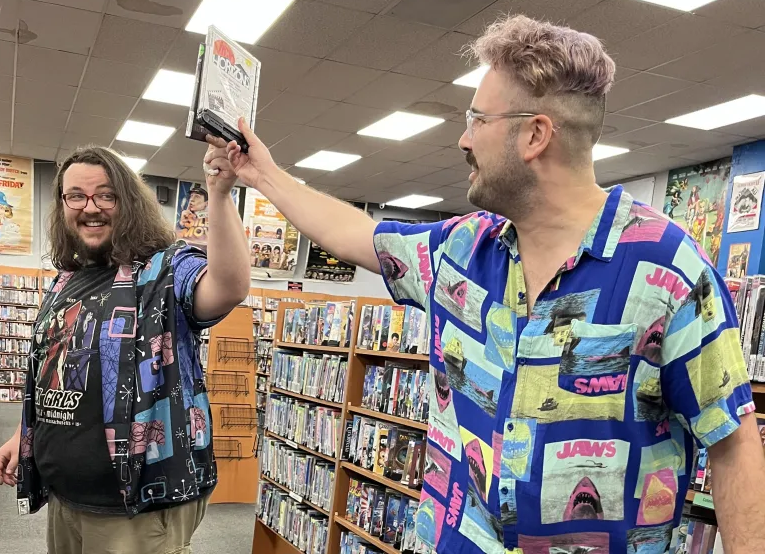
On January 6th, Video Horizons on Duane Street quietly reopened under new ownership. There was no giant inflatable tube man or ribbon-cutting ceremony. Just that familiar, comforting scent of plastic cases and carpet; the kind of smell that promises you’re about to find something weird to watch on a Tuesday night.
James Strecker and Coral Locke were behind the counter. Strecker is a native Astorian who actually worked at Video Horizons as a teenager. He spent years turning the idea of buying the store over in his head before he and Locke finally decided the timing was right. The previous owner, Neal Cummings, had run the place for 41 years, building it from a small VHS shop into the largest for-profit video rental store in the Pacific Northwest, with more than 60,000 titles and the stubbornness of someone who simply refused to believe the story was over. When he finally sold, he wanted it to stay local. It did.
What Strecker and Locke are building next is worth paying attention to. Not just as a local feel-good story, but as a small, well-stocked piece of evidence that something is genuinely shifting in how people relate to the films they love.
Let’s talk about streaming for a second. Because we need to.
Streaming is easy. Nobody’s arguing that. You press a button and a movie appears. Incredible. Revolutionary. And yet… you will spend 45 minutes scrolling through the morass, spiral through multiple services, open and close the same titles repeatedly in a kind of digital purgatory, and ultimately fall asleep on the couch twelve minutes into something you weren’t sure about to begin with.
You know this. We all know this.
Streaming services have become that flaky friend who promises to bring brownies to the party and then just… doesn’t show up. These services aren’t libraries. They’re temporary digital parking spots. When a corporate merger happens (and they keep happening) your favorite film doesn’t politely “leave the platform.” It gets vaporized. HBO came under fire in 2022 after their merger with Warner Bros. Discovery for removing a ton of titles with no explanation, some of which had never even made it to physical release. Gone. Probably because a spreadsheet said so.
But when you own the disc? No CEO in a suit can walk into your living room and take it off the shelf. That’s yours. The algorithm has no jurisdiction there.
Now the numbers, because they’re actually surprising.
The overall physical media market is still contracting; US disc sales came in around $870 million in 2025. Anyone claiming a full recovery is getting ahead of themselves. But here’s the part worth a double-take: the rate of decline slowed from 23% in 2024 to about 9% in 2025. That’s not a market collapsing. That’s a market finding its floor and planting a flag.
And inside that picture, specific things are growing. 4K Blu-ray sales rose 12% in 2025, the first year of growth in that format since 2018, which is wild considering most people assume the disc drive on their laptop is just a place to rest a coffee mug. Steelbooks, the collector-friendly metal cases that have become the holy grail for serious movie buyers, jumped 25% from 2023 to 2024. The Criterion Collection (the gold standard for serious home video) reported significant year-over-year sales increases, with its president crediting the growth directly to younger buyers.
These are not impulse purchases. Nobody accidentally buys a Criterion steelbook. These are deliberate, intentional acts of ownership from people who have decided that some films are worth keeping.
The vinyl parallel is almost too obvious to mention, and yet. In 2024, vinyl LP sales hit 43.6 million units in the US… the 18th consecutive year of growth, outselling CDs for the fourth year running. The resurgence didn’t happen because vinyl sounds better (though plenty of people will tell you it does, at length, at parties). It happened because holding a record, reading the liner notes, choosing a side, committing to the experience, turned out to matter in ways that a Spotify playlist never quite replaced. Physical media’s current moment is following the same pattern, compressed and accelerated by streaming fatigue and the growing awareness that digital “ownership” is, at best, a polite lie.
Here’s the generational piece, which is the most interesting part and the one that often gets dismissed.
For Gen Z, a DVD isn’t a relic. It’s a tactile experience. While older generations remember the genuine annoyance of “Please Rewind” stickers and late fees, younger collectors are discovering that shopping in your closet is infinitely more satisfying than doom-scrolling through Netflix until your dinner gets cold. One 24-year-old collector, having recently accumulated 200 discs, put it plainly: “I want something I can put on my shelf. I can go shopping in my closet and grab something and pop it in, instead of spending an hour scrolling through Netflix to find something and then just turning on the same TV show.”
That’s not nostalgia. That’s a critique of the entire streaming experience dressed up as a shopping preference. And it’s widespread enough that Barnes & Noble —one of the last major retailers still dedicating actual shelf space to physical media— reported DVD and Blu-ray sales growing by mid-double digits, with demographics skewing increasingly toward younger shoppers.
Vidiots, a well-known Los Angeles video store, had its biggest month ever in January 2026, renting an average of 170 movies a day, with 500 titles rented in a single day. Its director called the current moment a “golden age” for physical media. That is a Los Angeles video store. In 2026. On a planet where nearly everyone has a Netflix account.
The major studios remain ambivalent, which is its own kind of answer. Disney’s transition to Sony for physical distribution resulted in a noticeable drop in available titles at retail. This is a sign that the biggest players are still betting on streaming over physical access. But boutique labels are going entirely the other direction, investing in premium releases precisely because that’s where the committed, paying audience lives. The casual buyer may have moved to streaming. The person who genuinely loves film has not.
Which brings us back to Duane Street.
What Strecker and Locke are building at Video Horizons isn’t a museum piece or an act of nostalgia tourism. It’s a community space for people who want to engage with film deliberately… to browse, to get a recommendation from an actual human being instead of a, “Because you watched…” sidebar, to take something home and snap that case open with the specific satisfaction of a decision made. They’re planning a viewing area, a place to hang out, a reason to linger instead if just buying something.
That is almost exactly what the research says people are looking for. And frankly, it’s what Astoria has always been good at: taking the thing the rest of the world decided was over and keeping it alive long enough for everyone to realize they were wrong.
APS and Video Horizons are kindred spirits in this, natural co-conspirators in the same project. A store that treats film as something worth experiencing and a film organization that treats it as something worth understanding are pointing at the same thing. The object and the knowledge of how to read it. The shelf and the vocabulary to describe what’s on it.
What’s happening on Duane Street isn’t a funeral for the digital age. It’s a housewarming party for the physical one.
Visit Video Horizons. They promise that their discs won’t buffer.
Video Horizons is located at 1156 Duane St, in Astoria, Oregon. Open Tuesday–Thursday 11am–6pm, Friday–Saturday 11am–8pm.
APS Film School’s FILM 1 begins July 8th at Clatsop Community College. Learn more here.
